
Hull Rupture Resources: Full Economy Guide
Every confirmed Hull Rupture resource, what it feeds, and how to fix energy, fuel, minerals, and human shortages before they end the run.
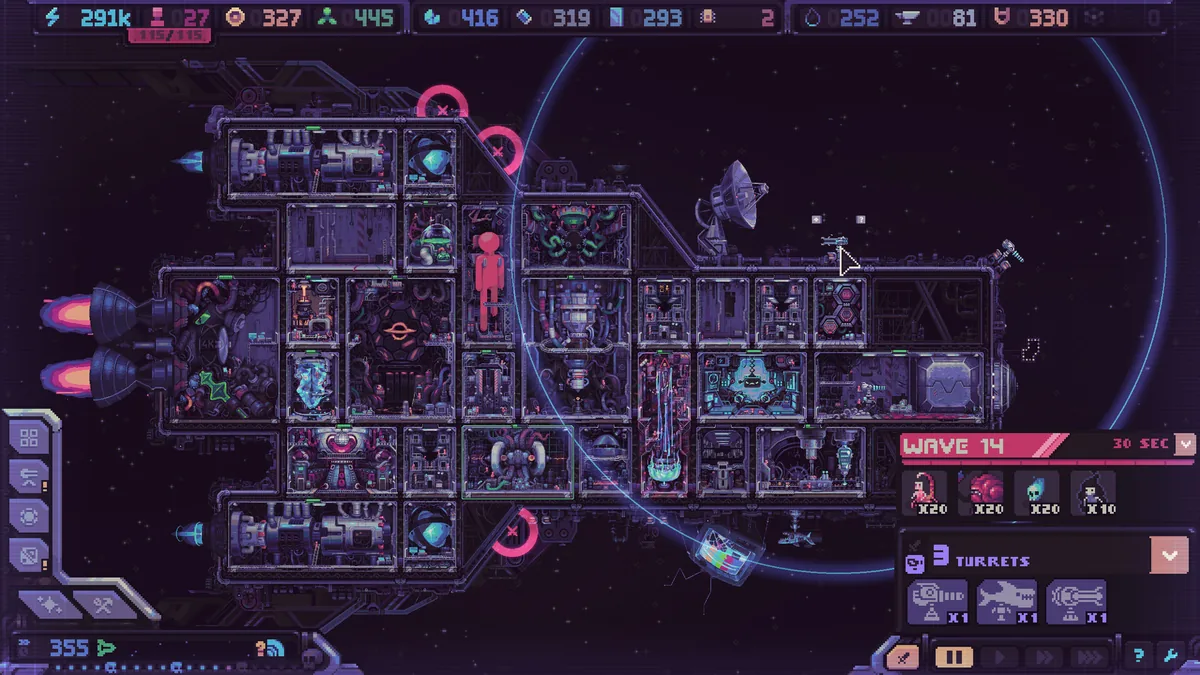
Hull Rupture's economy looks like a standard production chain until the first time you buy a module and discover you cannot install it. Tokens buy the kit; a second resource installs it. Humans run the room; energy keeps it powered. The ship is a stack of dependencies, and a shortage anywhere in the stack stops the whole line.
This page covers the resources that have appeared in the demo, devlogs, and hands-on previews, what they are used for, and how to diagnose a stalled economy.
"Every resource has its purpose. Humans included, while supplies last."
— Official source: Hull Rupture on Steam
The pages that explain the two bottlenecks are power and humans.
Banking tokens looks safe, but an unspent token is a module you did not install. Keep a repair reserve and spend the rest on production.
The four core resources
Four resources decide the opening: humans, energy, minerals, and fuel. Everything else is a later-layer material that depends on them.
Humans are workers, soldiers, event currency, and Bioreactor input. They are produced by the Reproducer and consumed by almost every system. A ship with no humans is a ship with no income.
Energy is produced by staffing the generator. It powers modules, repairs, and early hull construction. Energy is a flow rather than a stockpile: if income drops below upkeep, rooms brown out and production stops.
Minerals are the basic construction material. They feed hull blocks, module installation, and repairs. Mineral Generators are cheap to staff and easy to cluster near the Chamber.
Fuel moves the ship. A fuel shortage does not stop the run; it slows travel and forces more waves on the road. Engines also need workers, so fuel without crew is only half a solution.
Full resource table
| Resource | Primary source | Primary use | Notes |
|---|---|---|---|
| Humans | Reproducer | Staffing, events, Bioreactor | Also a currency in Cursed mode |
| Energy | Staffed generator | Power, repairs, early hull | Produced on a timer |
| Minerals | Mineral Generator | Construction, installation | Basic hull material |
| Fuel | Bioreactor, events, nodes | Engines, travel | Shortage slows rather than stops |
| Tokens | Waves, events, selling kits | Shop purchases | Does not install the item by itself |
| Microchips | Events, advanced production | High-tier modules | Preview shows event rewards |
| Nanobots | Advanced production | Advanced repairs/modules | Made easier in the September patch |
| Plasteel | Later production | Later hull blocks | Hull costs shift from Energy to Plasteel |
| Isotopes | Events, conditional modifiers | Advanced recipes | A 1x1 module modifier can generate them |
| Biofuel | Events, organic modules | Fuel chain | Preview event awarded 30 |
| Mystic Goo | Mystic Goo Generator | Conditional recipes | Some modifiers check its stock |
| Adamantium | Rare nodes/production | High-end construction | Late-run material |
The table is a map, not a recipe list. Exact installation costs change with the module, the ship, and the patch. The important pattern is that every advanced resource sits behind a chain of humans, energy, and a module you had to find.
Tokens buy, materials install
The shop does not sell finished rooms. It sells kits, and a kit still needs the right materials to install. That is why a run can have plenty of tokens and still be stuck.
Before you buy a crate, check three things:
- Do you have the installation material? A powerful module you cannot install is dead weight in the inventory.
- Do you have a slot next to a completed module? An empty slot is only buildable when a completed module is adjacent.
- Do you have the humans and energy to run it? A module that browns out is worse than an empty slot.
The shop's themed crates make this harder. You choose a category, not a specific module, so the kit may not match your stockpile. Selling the kit is often the correct move.
Energy is a flow, not a stockpile
The generator produces energy as long as humans are assigned, on a timer. That makes energy income a function of population and staffing, not a number you can bank forever.
Three habits keep the flow stable:
- Keep one spare human. When a worker dies in an event, the spare keeps the generator running while the Reproducer replaces the loss.
- Do not staff a new module by emptying the generator. Move a human from a low-value room, not from the room that powers everything.
- Repair before you expand. A damaged generator loses uptime, and lost uptime compounds across waves.
If energy is negative, do not build a new producer. Fix the staffing first. The new producer will only make the brownout worse.
Humans as a resource
The game's pitch is that humans are disposable, and the mechanics support it. Humans can be:
- assigned to generators, engines, and production rooms
- converted to fuel in the Bioreactor
- spent in narrative events that demand a population sacrifice
- used as the only currency in Cursed mode
- killed by events, waves, and your own bad layout
The counterweight is that humans are slow to replace. The Reproducer takes time, and a population crash can leave you unable to staff the rooms you already built. That is why the Reproducer is usually the second or third module in a serious run.
A useful rule: never convert your last ten humans. Events that ask for 20 humans become unavailable below the threshold, and a Bioreactor that eats the workforce is a slow loss. Keep a buffer, then convert the surplus.
Fixing a stalled economy
When production stops, diagnose in this order:
| Symptom | Likely cause | Fix |
|---|---|---|
| Energy bar empty | Generator understaffed or destroyed | Reassign humans; repair generator |
| Minerals flat | No Mineral Generator or no workers | Build/staff one; check adjacency |
| Fuel falling | Bioreactor idle or no fuel income | Staff Bioreactor; take fuel nodes |
| Tokens high, can't build | Missing installation material | Sell kit or produce the material |
| Modules brown out | Energy upkeep exceeds income | Add generator capacity before new modules |
| Ship too slow | Too much mass, too few engines | Add engines or stop expanding |
Fix the lowest layer first. Adding a Microchip producer to a ship with no energy is not progress; it is a more expensive brownout.
Resource priorities by phase
Waves 1–5: humans, energy, minerals. Build the Reproducer, staff the generator, and get one Mineral Generator running.
Waves 6–10: fuel and defense. Add engines, cover the airlock, and start producing the material your next module needs.
Waves 11–15: advanced materials. Microchips, Nanobots, and Plasteel start to gate your upgrades. Pick one advanced chain and commit.
Waves 16–20: repair and sustain. The economy should be self-running; your attention belongs on breaches, turret moves, and the final boss.
The exact wave where each material appears depends on your ship and mode. The principle does not: each phase should leave the previous phase's income intact.
Sources and further reading
Related
- The energy budget behind every module
- How population becomes a resource
- Which module produces which resource
FAQ
What is the most important resource? Humans. They produce energy, staff every module, and are the input for the Bioreactor. A ship with humans and no minerals can recover; a ship with minerals and no humans cannot.
Can the ship run without fuel? It moves slowly rather than stopping completely. A fuel shortage costs time and forces extra waves, but it is not an instant loss.
What are tokens used for? Shop purchases. Tokens buy kits and crates, while installation consumes a specific material.
How do I get more humans? Build a Reproducer and staff it. Some events and galaxy nodes also award humans.
What is Mystic Goo for? It is an advanced resource used in conditional recipes and modifiers. The Mystic Goo Generator is the confirmed source.
Do resources carry between runs? No. Resources are per-run. Artifacts are the between-run progression layer.
More Hull Rupture Guides
How Hull Rupture's hull construction works: the 15-block deck, placement rules, stilt corridors, costs, and layouts that survive late waves.
Hull Rupture treats humans as a resource. Learn where to assign them, when to convert them in the Bioreactor, and how to avoid a population death spiral.
How Hull Rupture modifiers and artifacts work: shop vs event pools, confirmed effects, conditional bonuses, and which builds are worth committing to.
Hull Rupture module guide: confirmed production rooms, adjacency bonuses, module kits, selling duplicates, and placement rules for a stable ship.
Hull Rupture launches on PC, Mac, and Linux on November 4, 2026. There is no PS5, Xbox, Switch, or mobile version. Here is the full platform status.
How Hull Rupture's energy economy works: generator staffing, module upkeep, brownout recovery, and when to stop building before the ship stalls.
Hull Rupture has no full reviews yet. Here is what the April preview build praised, what it criticized, and how the demo's reception frames the launch.
Hull Rupture releases November 4, 2026 on PC, Mac, and Linux. Here is what Steam has confirmed about the price, launch time, demo, and day-one content.