
Hull Rupture Modules: Production and Synergy
Hull Rupture module guide: confirmed production rooms, adjacency bonuses, module kits, selling duplicates, and placement rules for a stable ship.
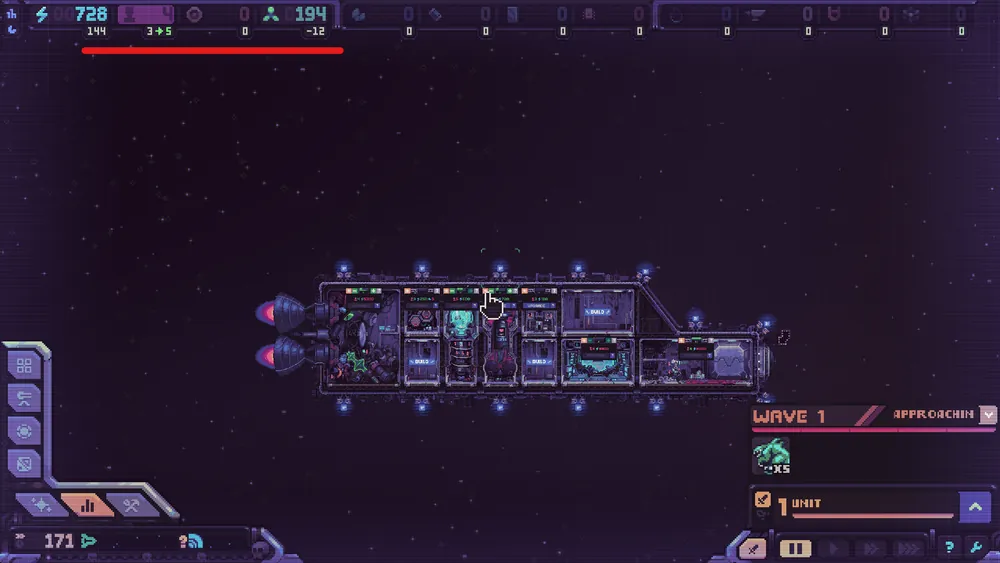
Modules are the rooms inside your hull. They produce resources, house humans, convert one material into another, or improve the rooms next to them. Hull blocks decide the ship's shape; modules decide whether that shape generates anything.
The system is deliberately cramped. A module needs a slot, a slot needs an adjacent completed module, and every room needs humans or energy to run. The result is a ship that grows in clusters rather than clean rows, and the clusters are where the real bonuses live.
"Certain modules buff adjacent structures. Despot's Chamber, for example, improves the efficiency of neighboring modules."
— Official source: Hull Rupture Devlog #1
The two systems that decide whether a module pays off are resources and power.
The shop sells kits; installing one also costs energy or a material and needs a free slot. Do not buy a kit you cannot install this wave.
Modules, hull, and systems
The game uses three related but distinct building layers:
- Hull blocks are the physical outline. They are permanent and cannot be rotated.
- Modules are rooms placed into slots inside the hull. Most can be demolished for a partial refund.
- Systems are fixed or semi-fixed parts such as the airlock, engine, and Despot's Chamber.
A module is not the same as a hull block. You do not place a "Mineral Generator block" on the outside of the ship; you open a slot with hull, then install the module inside it. That distinction matters when you are planning a layout: the hull is the constraint, the module is the payload.
Turrets sit on the hull and are a separate category. They can be moved for free, but the move takes a long time and leaves the turret with downtime afterward. Modules cannot be moved in the demo. Konfa has said module swapping and removal are planned for the full version, with a cooldown.
Confirmed production modules
Konfa has shown several modules across devlogs and previews. The list below is limited to modules that have appeared in official material or hands-on previews; the full release has more.
| Module | Input | Output | Role |
|---|---|---|---|
| Reproducer | Energy, time | Humans | Worker growth |
| Bioreactor | Humans | Fuel / goo | Population conversion |
| Mineral Generator | Energy, workers | Minerals | Basic construction |
| Mystic Goo Generator | Energy, workers | Mystic Goo | Advanced resource |
| Energy Generator | Humans | Energy | Powers everything |
| Engine | Fuel, workers | Travel speed | Galaxy map movement |
| Despot's Chamber | Humans | Free module kits | Economy multiplier |
The Reproducer and Bioreactor are a pair: one makes humans, the other spends them. A ship with a strong Reproducer can afford a Bioreactor; a ship without one is trading its future for short-term fuel.
The Mineral Generator and Mystic Goo Generator are the production backbone. Minerals feed hull and module construction; Mystic Goo feeds the stranger, more conditional recipes. Neither works without energy, and energy does not work without humans.
Adjacency and the Despot's Chamber
Adjacency bonuses are the difference between a functional ship and a good one. The Despot's Chamber improves the efficiency of neighboring modules, so the rooms around it should be the ones you want to run constantly.
A practical pattern:
- Put the Chamber at the center of a compact block.
- Surround it with your highest-throughput production modules.
- Put storage, housing, or low-value rooms on the outer ring.
- Keep the airlock and repair coverage on a separate axis so a breach does not cut the Chamber off.
Do not put a module next to the Chamber just because the slot is open. If the room is idle most of the run, the bonus is wasted. The Chamber's aura is a multiplier on activity, not a reason to build activity.
Other modules also buff neighbors. The exact adjacency rules are discoverable in-game, and they are one of the reasons the community shares layout screenshots. A room that looks inefficient alone can be correct in a cluster.
Module kits and duplicates
Modules are acquired as kits, not built from scratch. The post-battle shop sells themed crates that contain module or turret kits, and some modules drop with modifiers already installed.
Three sources matter:
- The shop. Themed crates (Defense, Humans, Rare in the current build) offer a random kit from a pool.
- The Despot's Chamber. Humans assigned there produce free random module kits slowly. More workers means more kits.
- Events and the galaxy map. Some nodes and narrative events award modules, artifacts, or resources.
Duplicates are not useless. A second Mineral Generator can be the difference between affording a hull block and waiting a wave. But a duplicate of a module you cannot staff is a wasted slot, and slots are the scarcest thing on the ship.
Unwanted kits can be sold in the shop. That is the release valve for a bad draw: instead of building a room you do not need, convert the kit into resources and keep the slot open for something better.
Placement rules of thumb
Put production near the Chamber, defense near the airlock. The two clusters overlap, but they are not the same. A turret does not need the Chamber's bonus; a generator does.
Keep the repair path short. If a repair module or repair crew has to cross the entire ship, a breach on the far side becomes a second wave.
Do not stack humans in one room if a second room is idle. A human in an unstaffed generator produces nothing. Moving one worker often beats building a new module.
Leave one empty slot near the Chamber. The deck is random. An open slot lets you install a good kit immediately instead of waiting for hull construction.
Build the Bioreactor after the Reproducer, not before. Converting humans to fuel is powerful, but it is a one-way trade. If the population is not growing, the Bioreactor is eating your workforce.
When to demolish
Demolishing a module returns its resources but not the kit. That makes it a reset of the room, not a refund of the gamble.
Demolish when:
- The module is redundant and its slot is needed for a higher-throughput room.
- The room is too far from the Chamber to receive the bonus and too expensive to keep staffed.
- A modifier or event has made the module's output obsolete.
Do not demolish a production module just because a wave went badly. Repair the breach, replace the humans, and keep the chain running. A temporarily idle room is cheaper than a new kit.
Sources and further reading
Related
- What each module produces and consumes
- How module upkeep causes brownouts
- How to create slots for new modules
FAQ
How many modules are in Hull Rupture? The full count has not been published. The demo shows a subset of production, housing, and conversion modules.
Can modules be moved? Not in the demo. Turrets can be moved for free with a long downtime; module swapping is planned for the full version but is not available yet.
Do adjacency bonuses stack? The game supports adjacency buffs, and the Despot's Chamber is the confirmed example. Exact stacking rules are shown in-game.
What happens to a module when I demolish it? You get the resources back, but not the kit. The slot becomes empty and can be rebuilt with another kit.
Are modules random? Kits are random from crates and the Chamber. The shop's pools are themed, so you can influence the category but not the exact room.
More Hull Rupture Guides
Hull Rupture has six modes at launch. Here is what Classic, Trade, Cursed, and Endless do, plus which modes are confirmed and which are still unnamed.
How Hull Rupture's hull construction works: the 15-block deck, placement rules, stilt corridors, costs, and layouts that survive late waves.
Hull Rupture treats humans as a resource. Learn where to assign them, when to convert them in the Bioreactor, and how to avoid a population death spiral.
How Hull Rupture modifiers and artifacts work: shop vs event pools, confirmed effects, conditional bonuses, and which builds are worth committing to.
Hull Rupture launches on PC, Mac, and Linux on November 4, 2026. There is no PS5, Xbox, Switch, or mobile version. Here is the full platform status.
How Hull Rupture's energy economy works: generator staffing, module upkeep, brownout recovery, and when to stop building before the ship stalls.
Hull Rupture has no full reviews yet. Here is what the April preview build praised, what it criticized, and how the demo's reception frames the launch.
Hull Rupture releases November 4, 2026 on PC, Mac, and Linux. Here is what Steam has confirmed about the price, launch time, demo, and day-one content.