
Hull Rupture Difficulty Levels Explained
Hull Rupture has four difficulty levels. Here is what they change, how they interact with modes, and why Impossible is a mode rather than a difficulty setting.
Hull Rupture ships with four difficulty levels. They sit on top of the six game modes, which means the difficulty you pick is separate from the rules you play by. Classic on the lowest difficulty and Cursed on the highest are not two points on the same line; they are different games with different numbers.
The names and exact modifiers of the four levels have not been published. What is confirmed is that difficulty changes the pressure, and at least one feature — guarded galaxy locations — is planned for higher difficulties in the full release.
"The problem is that you never fully know how much defense is enough defense."
— Official source: Hull Rupture Devlog #1
For the rules first, read game modes; for the layer that fails first, read defense.
Cursed on low difficulty is still a different economy from Classic on high difficulty. Pick the rules first, then the numbers.
The four levels
| Level | Name | Confirmed changes | Recommended for |
|---|---|---|---|
| 1 | Unpublished | Baseline enemies and economy | First run; learning the systems |
| 2 | Unpublished | Stronger pressure | Second run; comfortable with Classic |
| 3 | Unpublished | Higher pressure; guarded nodes likely | Experienced strategy players |
| 4 | Unpublished | Maximum pressure | Players who have finished a run |
The store page confirms four levels but does not name them. Any guide that gives you four names is guessing unless it cites the release build. The demo's difficulty cards are visible in the ship-select screen, but the full balance is a launch question.
Do not assume the levels are simple multipliers. A difficulty that only increases enemy HP would make turrets mandatory and production optional; a difficulty that increases economic pressure would do the opposite. The interesting design space is in the mix.
What difficulty changes
Only one difficulty-gated feature is confirmed: guarded locations. Konfa has said these are planned for the full release at higher difficulties, and they trigger extra waves that do not count toward the Classic 20.
That is a meaningful change, not a stat tweak. A guarded node is an optional high-risk reward; on a higher difficulty, the map may offer more of them, or only offer them there. Either way, the route becomes more dangerous.
The rest is inference from the genre:
- Enemy health, damage, and wave composition may scale.
- Resource income or starting resources may be reduced.
- Repair costs or build costs may increase.
- The number of waves may stay at 20 while the waves themselves get harder.
None of those is confirmed. Treat them as expectations, not facts.
Difficulty vs mode
This is the most common confusion in pre-release discussion. Two labels from the April preview build, Pure and Impossible, are modes, not difficulty levels.
- Pure was described as a mode with less RNG and no random events.
- Impossible was described as a mode unlocked after completing the campaign once, "at the verge of madness."
Those are rule changes. The four difficulty levels are a separate axis. A run can be Impossible mode on difficulty 2, or Classic on difficulty 4.
The preview names may not survive to launch. The distinction is what matters: if a choice changes the rules, it is a mode; if it changes the numbers, it is a difficulty.
Which difficulty should you start on?
Start on the lowest difficulty for your first Classic run. The game has three systems to learn — production, hull construction, and defense — and the first run is a tutorial whether the game calls it one or not.
Move up when:
- You finish a Classic run without losing the airlock.
- You understand why your economy stalled, not just that it did.
- You can reach wave 15 with a repair reserve.
Do not move up because a run felt easy. A run can feel easy because the shop gave you a strong build, not because you mastered the difficulty. Play a second run with a different modifier draw before judging.
If you are an experienced roguelite player, start one level above the lowest. The opening is slow, and the first two waves are not a meaningful test.
Habits that scale with difficulty
Higher difficulty punishes inefficiency before it punishes bad luck. These habits matter at every level, but they become mandatory:
Keep the ship compact. More hull means more mass, more repair surface, and more alien routes. A tight ship is easier to defend and faster on the map.
Build economy before defense, but not too much. The developers' own framing is that the optimal strategy is the minimum defense that survives, with everything else going into economy. On higher difficulty, the minimum is higher, but the principle holds.
Hold a repair reserve. A run that spends its last energy on a module before a boss wave is a run that loses to the first breach.
Take the safe route when the ship is fragile. A guarded node is not worth a dead airlock. On higher difficulty, the map's risk/reward curve is steeper.
Do not chase a build you cannot staff. A rare module with no workers is a liability. The tier list is a guide, not a mandate.
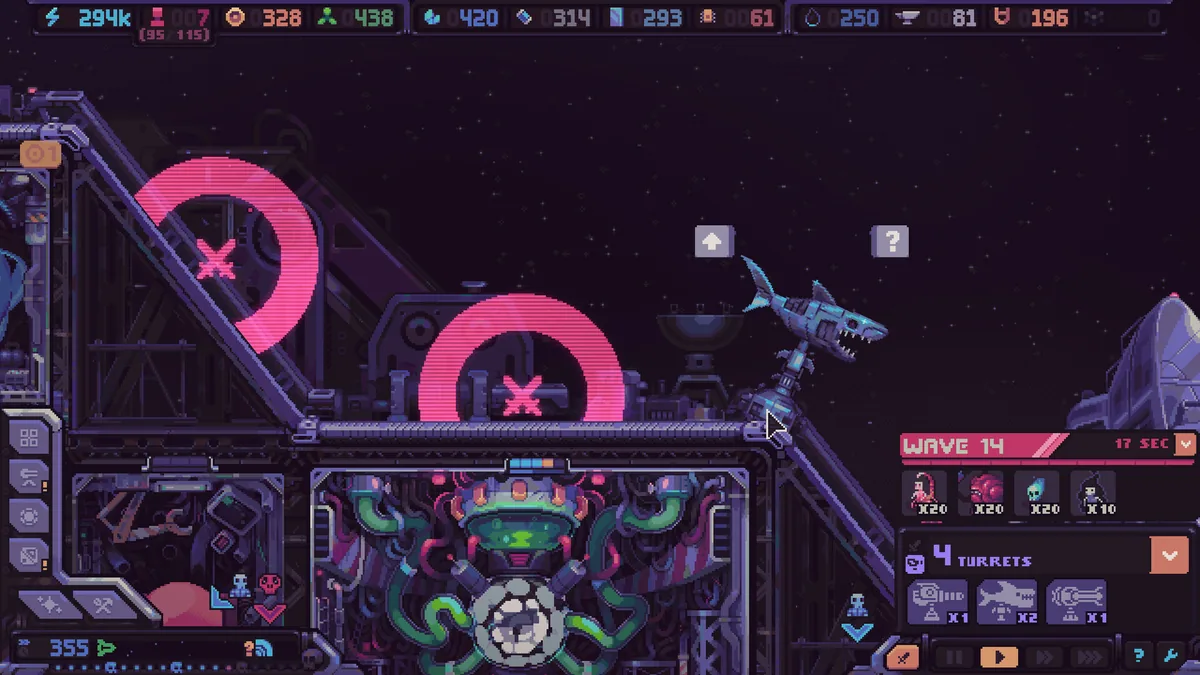
Guarded locations and extra waves
Guarded locations are the confirmed difficulty-gated content. They offer high-value rewards and trigger extra waves, which do not count toward the Classic 20.
That last detail is important. A guarded node does not shorten the campaign; it adds a fight on top of it. On a higher difficulty, that fight is harder, and the reward is correspondingly more valuable.
Take a guarded node when:
- The airlock has a dedicated turret and a repair path.
- The ship has a repair reserve.
- The reward fits the build (a modifier or module you can use).
- The next campaign wave is not a boss.
Skip it when the ship is already behind. A delayed boss is still a boss.
Is there a hardest difficulty reward?
No cosmetic or gameplay reward for the highest difficulty has been announced. The store page does not mention achievements, unlockable skins, or difficulty-specific endings.
If the release adds difficulty rewards, they will likely be tied to ship configurations or artifacts, which are the game's existing progression layers. Until then, play the difficulty that gives you the experience you want.
Sources and further reading
Related
- The six modes and their win conditions
- The layer that fails first on high difficulty
- How guarded nodes raise the risk
FAQ
How many difficulty levels does Hull Rupture have? Four. The names and exact modifiers have not been published.
Is Impossible a difficulty? No. In the preview build, Impossible was a mode, not a difficulty level. It may be renamed at launch.
Can I change difficulty mid-run? No mid-run change has been announced. The choice is made at the start.
Does difficulty affect the galaxy map? At least one feature is difficulty-gated: guarded locations are planned for higher difficulties.
Which difficulty is canon? There is no canon. The campaign's story is the same; difficulty changes the pressure, not the ending.
Should I play Classic or Cursed on high difficulty? Classic first. Cursed changes the economy, so it teaches different lessons. Learn the baseline before inverting it.
More Hull Rupture Guides
Hull Rupture treats humans as a resource. Learn where to assign them, when to convert them in the Bioreactor, and how to avoid a population death spiral.
How Hull Rupture modifiers and artifacts work: shop vs event pools, confirmed effects, conditional bonuses, and which builds are worth committing to.
Hull Rupture module guide: confirmed production rooms, adjacency bonuses, module kits, selling duplicates, and placement rules for a stable ship.
Hull Rupture launches on PC, Mac, and Linux on November 4, 2026. There is no PS5, Xbox, Switch, or mobile version. Here is the full platform status.
How Hull Rupture's energy economy works: generator staffing, module upkeep, brownout recovery, and when to stop building before the ship stalls.
Hull Rupture has no full reviews yet. Here is what the April preview build praised, what it criticized, and how the demo's reception frames the launch.
Hull Rupture releases November 4, 2026 on PC, Mac, and Linux. Here is what Steam has confirmed about the price, launch time, demo, and day-one content.
How repair works in Hull Rupture: breach priority, energy costs, repair module placement, and when to abandon a damaged section instead of rebuilding it.