
Hull Rupture Humans Guide: Staffing and Sacrifice
Hull Rupture treats humans as a resource. Learn where to assign them, when to convert them in the Bioreactor, and how to avoid a population death spiral.
Hull Rupture's joke is also its core mechanic: humans are livestock with a job title. They staff your generators, reproduce in the Reproducer, get rendered into fuel in the Bioreactor, and die by the dozen in events that the game presents as ordinary management decisions.
The joke stops being funny when a population crash leaves you unable to staff the rooms you already built. Humans are the only resource that both produces and consumes itself, so the population curve is the run's real difficulty curve.
"Did you know the energy from one human leg can accelerate a spaceship by 0.37%? Amazing!"
— Official source: Hull Rupture Devlog #1
For the conversion loop, see modules; for the defense trade-off, see defense.
Converter automation keeps sending humans while the queue is above one. Turn it off before an event or a boss wave that needs population.
Why humans are a resource
The game does not hide the framing. The store description calls them "puny humans" and says you treat them as resources. The Cursed mode goes further: it removes money entirely and makes humans the currency.
Mechanically, humans are:
- Workers for energy, production, engines, and the Despot's Chamber
- Fuel input when converted in the Bioreactor
- Event currency when a narrative choice demands a sacrifice
- Shop currency in Cursed mode
- Defense in the sense that a dead human is one less alien target, but not in any useful sense
They are not individually named, leveled, or equipped. You manage populations, not people. That is the point.
Where to assign humans
Every assignment is an opportunity cost. The same worker cannot generate energy and staff a Mineral Generator at the same time.
| Assignment | What it produces | Priority |
|---|---|---|
| Energy generator | Energy | Highest; everything depends on it |
| Reproducer | More humans | High in the opening and after losses |
| Mineral Generator | Minerals | High; gates construction |
| Despot's Chamber | Free module kits | Medium; compounding but slow |
| Engines | Travel speed | Medium; depends on the route |
| Bioreactor | Fuel | Medium; only with surplus humans |
| Turrets | Not staffed | N/A; turrets are automated |
The opening order is generator, Reproducer, Mineral Generator. After that, the Chamber is usually the best long-term assignment because free kits save tokens and slots. Engines come before a long route, not after.
Do not staff the Bioreactor until the Reproducer can replace the loss. A Bioreactor that consumes more humans than the Reproducer produces is a slow suicide.
The Reproducer
The Reproducer is the only confirmed way to grow the population. It consumes energy and time, and it produces humans.
Three rules keep it useful:
- Build it early. A Reproducer online at wave 3 has paid for itself by wave 10.
- Keep it staffed. An idle Reproducer is a room-sized tax.
- Protect it. It belongs near the Chamber and away from the alien approach, not on the outer hull.
The Reproducer's output is not instant. That delay is why population losses hurt: you cannot replace a wave's casualties before the next wave unless you already have a buffer.
The Bioreactor trade
The Bioreactor converts humans into fuel or goo. It is the most seductive bad decision in the game, because fuel is always useful and humans are always available.
Use it when:
- The population is above your staffing needs plus a buffer.
- The route ahead needs fuel and there is no better source.
- A modifier or event makes the conversion unusually efficient.
Do not use it when:
- The Reproducer is offline or understaffed.
- You are below the threshold for an event option you want.
- The next wave is close and you need every worker for repairs.
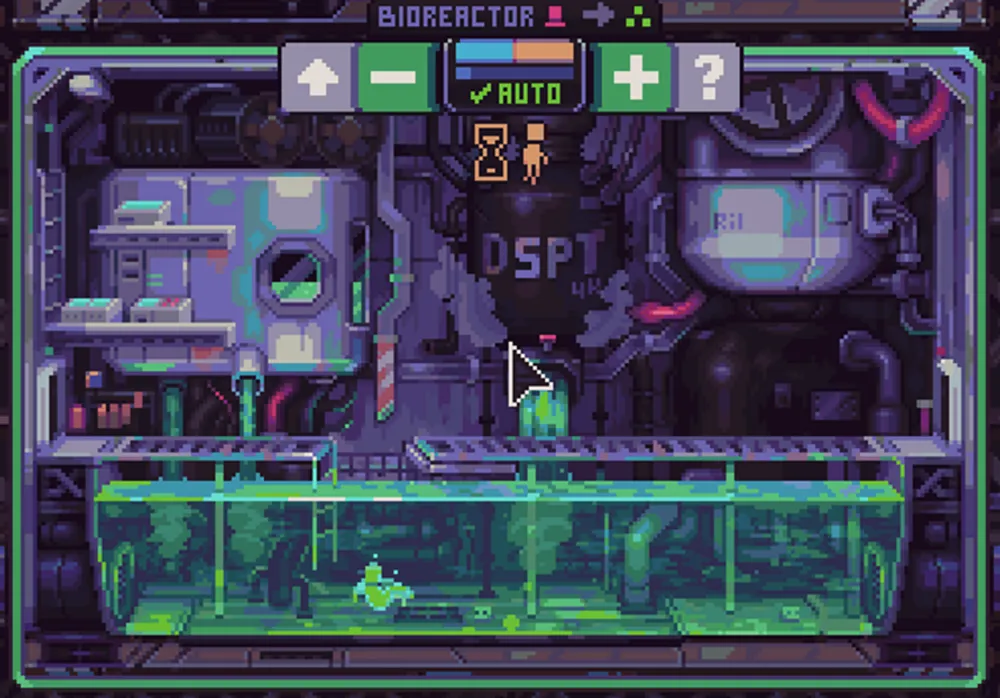
The September patch added an Auto button that sends humans to the Bioreactor and then sends another when only one remains in the queue. Automation is convenient, but it will happily eat your buffer. Check the queue before you enable it.
Event thresholds
Some narrative events check your population before offering a choice. The preview's example was a sacrifice option requiring 20 humans; if the workforce was below 20, the option was unavailable.
That creates a hidden cost to population loss: you do not just lose workers, you lose access to choices. A run with 15 humans may be unable to take the "good" branch of an event that a run with 25 humans can.
Keep a buffer above the largest threshold you have seen. Twenty is a useful early target; thirty is comfortable once the Reproducer is running.
Cursed mode changes the math
In Cursed mode, there is no money. Humans are the currency, and every purchase spends population.
That inverts the usual priority. The Reproducer becomes the economy, the Bioreactor becomes a luxury, and events that offer humans become premium. A Cursed run that spends its population on modules without replacing it will stall faster than any Classic run.
Cursed is not a harder Classic; it is a different economy. The habits that keep a Classic run alive (convert surplus humans, bank tokens) are the habits that kill a Cursed run.
Avoiding a population death spiral
A death spiral starts with a wave that kills more humans than the Reproducer can replace. The next wave is worse because the generator is understaffed, which reduces energy, which delays repairs, which kills more humans.
Break the spiral early:
- Move humans to the generator. Energy first, production second.
- Pause the Bioreactor. Stop converting your replacement rate.
- Repair the Reproducer. It is the only way out of the hole.
- Take human rewards over module rewards. A module you cannot staff is not a reward.
- Skip the shop. Tokens do not fix a population crisis.
If the population is below the staffing needs of your existing rooms, demolish a room. An empty slot is better than a room that permanently drains your workforce.
Sources and further reading
Related
- How humans fit into the resource chain
- The Reproducer and Bioreactor pair
- Why defenders are the last resort
FAQ
How do humans reproduce? Through the Reproducer, which consumes energy and time. Some events and nodes may also award humans.
Can I name or level individual humans? No. Humans are a population resource, not individual units.
Should I always staff the Despot's Chamber? It is a strong default after the generator and Reproducer, because free module kits compound. Drop it if the ship needs energy or repairs more.
What happens if the population reaches zero? The run ends or becomes unrecoverable, depending on the mode. There is no way to produce humans without a Reproducer or an event.
Is Cursed mode the only mode where humans are currency? Yes. Classic and Trade use tokens for the shop; Cursed replaces money with humans.
More Hull Rupture Guides
How Hull Rupture's hull construction works: the 15-block deck, placement rules, stilt corridors, costs, and layouts that survive late waves.
How Hull Rupture modifiers and artifacts work: shop vs event pools, confirmed effects, conditional bonuses, and which builds are worth committing to.
Hull Rupture module guide: confirmed production rooms, adjacency bonuses, module kits, selling duplicates, and placement rules for a stable ship.
Hull Rupture launches on PC, Mac, and Linux on November 4, 2026. There is no PS5, Xbox, Switch, or mobile version. Here is the full platform status.
How Hull Rupture's energy economy works: generator staffing, module upkeep, brownout recovery, and when to stop building before the ship stalls.
Hull Rupture has no full reviews yet. Here is what the April preview build praised, what it criticized, and how the demo's reception frames the launch.
Hull Rupture releases November 4, 2026 on PC, Mac, and Linux. Here is what Steam has confirmed about the price, launch time, demo, and day-one content.
How repair works in Hull Rupture: breach priority, energy costs, repair module placement, and when to abandon a damaged section instead of rebuilding it.